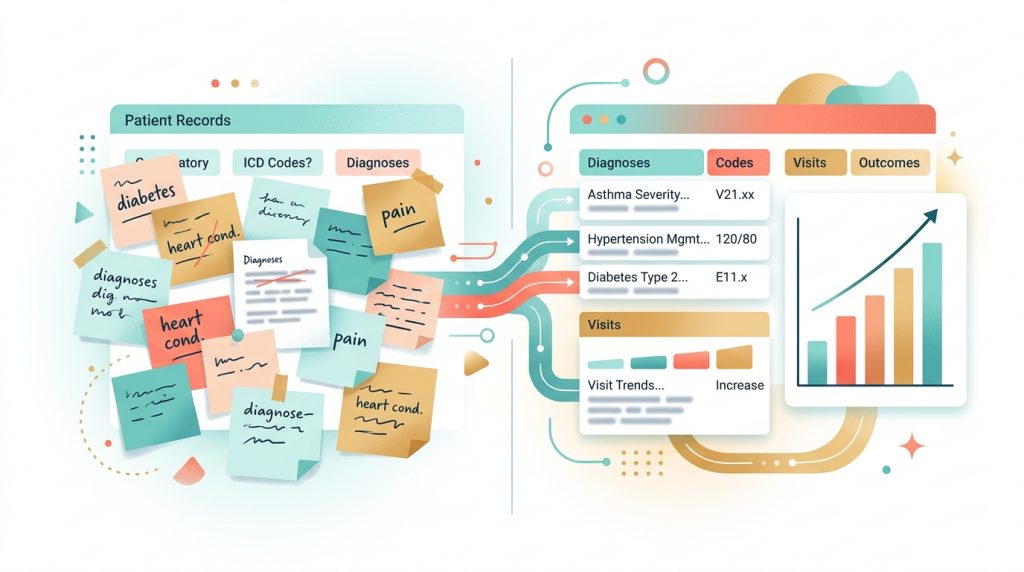
Somewhere in your clinic right now, there's a patient record that says "shoulder problem." Another says "R shoulder: impingement?" A third says "right shoulder pain, likely subacromial bursitis, consider rotator cuff." All three patients might have the same condition. Good luck proving it.
You could hire a literary critic to unify them. Or you could start coding diagnoses properly.
If you're a clinical director who's ever wanted to audit outcomes, contribute to a research paper, or even just answer the question "how are our patients with condition X actually doing?", you've probably hit this wall. The clinical data is there. It's just buried in free-text notes, written in slightly different ways by every practitioner on your team, and functionally impossible to search at scale.
The fix isn't a research assistant or a weekend with a highlighter. It's structured diagnosis coding at the point of care, and it takes far less effort than you think.
Free-text diagnosis entries feel efficient in the moment. The practitioner types what they mean, moves on, sees the next patient. But every time a diagnosis is recorded as prose rather than a standardised code, it becomes invisible to any structured query.
Want to pull every patient diagnosed with chronic migraine in the last two years? If your records contain "chronic migraine," "migraine, chronic type," "frequent migraines," and "migraine disorder (chronic)," you're not running a database query. You're reading notes one by one.
This is the core problem for clinical research in private practice. NHS trusts have coding teams. Private clinics usually have an intern with a highlighter and a dream.
So the data stays unstructured, the audit never happens, and that paper you've been meaning to write stays in a folder on your desktop, right next to "New Website Ideas" and that PDF about Pilates you definitely meant to read.
When a practitioner selects a standardised diagnosis code during the consultation, whether your clinic is using ICD-10 or SNOMED CT, that diagnosis becomes a structured, searchable, filterable data point. Not later. Not after a coding review. Right then.
This matters because it means:
The perceived barrier has always been time. Practitioners picture clinical coding as a separate administrative task, something that slows down the consultation. That perception is outdated.
In Function 365, diagnosis coding happens inline, directly in the (telehealth) appointment, or the Document Editor. There's no separate coding screen, no context switch, no workflow interruption.
The Diagnosis Code Search Settings in the Admin Panel let your practice choose between ICD-10 and SNOMED CT, depending on your needs. UK medically-led practices increasingly need the granularity of SNOMED CT's 2.6 million plus codes. North American and insurance-driven practices often prefer ICD-10. You pick what fits.
When a practitioner adds a diagnosis, the real-time lookup searches across the full code set and returns results in under three seconds. Type a few characters, select the code, done. It adds seconds to an encounter, not minutes, and those seconds save you weeks when you actually need the data.
Here's what this looks like in practice.
Dr Olivia is a clinical director at a multidisciplinary MSK clinic with eight practitioners. She wants to publish a paper on treatment outcomes for patients presenting with chronic low back pain, specifically whether patients who followed a structured rehabilitation protocol showed measurably better outcomes than those who received standard care.
Without structured coding, Dr Olivia's first step would be identifying every chronic low back pain patient from the last 18 months. That means reading through clinical notes, interpreting different practitioners' shorthand, and manually building a spreadsheet. Conservatively, that's two to three weeks of evenings and weekends before she's even started analysing outcomes.
With structured coding in place, Dr Olivia filters her patient list by the relevant SNOMED CT or ICD-10 code. Every patient diagnosed with chronic low back pain appears instantly, regardless of which practitioner saw them or how they might have described it in their notes. The identification step that would have taken weeks takes minutes.
But diagnosis codes alone don't make a research dataset. You also need outcomes data.
This is where things get genuinely powerful. When you combine structured diagnosis codes with standardised outcome measures, you have both sides of the research equation: who has the condition, and how they're progressing.
Function 365's Health Scores and Biomarkers feature lets you create and track any recognised outcome measure, whether that's an Oswestry Disability Index for back pain, a PHQ-9 for depression, or a custom score your specialty uses. (Note that your clinic will need a license for using measures under copyright from the copyright holder) Smart Intake reminders ensure patients actually complete them, so your dataset doesn't have gaps.
Back to Dr Olivia's scenario: she now has a cohort of patients identified by diagnosis code, each with longitudinal outcome scores recorded at intake and follow-up points. She can filter by diagnosis, age, treatment protocol, or practitioner. She can visualise score changes with line charts or matrix views directly in the Patient Hub. And when she's ready to export, the data comes out structured and automatically anonymised, ready for analysis without a separate de-identification step.
The prep work that would have consumed weeks of manual effort is reduced to hours. The research question she's been sitting on for two years suddenly looks achievable before the next conference deadline.
There's a compounding benefit here that's easy to overlook. Every consultation where a practitioner codes a diagnosis adds another data point to your clinic's structured dataset. Over months and years, you're building something genuinely valuable, not just for one research project, but for ongoing clinical audit, quality improvement, and business intelligence.
Want to know which conditions your clinic sees most frequently? Which are growing? How outcomes compare across practitioners or treatment approaches? That's all queryable when the underlying data is coded.
And because the coding happens at the point of care, inside the same workflow the practitioner is already using, there's no separate data-entry step to forget, defer, or resent.
If you're thinking "great, but my practitioners are already drowning in documentation", fair point. Coding only works as a sustainable practice if it doesn't add to an already heavy admin load.
This is partly why the inline approach matters so much. But it's also worth noting that Function 365's AI-Powered Documentation can draft the consultation write-up from the interaction transcript and real-time practitioner-approved observations. When your practitioners are spending 70 to 80 percent less time on charting, the three seconds it takes to select a diagnosis code feels like what it is: trivial.
Most clinical directors in private practice have at least one research question they'd love to answer. Maybe it's a paper. Maybe it's an internal audit to refine a care pathway. Maybe it's simply being able to show prospective patients, with real data, that your treatments work.
The barrier has rarely been ambition or clinical expertise. It's been the data. Specifically, the hours of manual work needed to wrangle unstructured notes into something analysable.
Structured diagnosis coding removes that barrier. Not by adding a new task to your practitioners' day, but by turning something they already do, recording a diagnosis, into a structured, searchable, research-ready data point. In under three seconds.
If you've been putting off that audit or research project because the data prep felt overwhelming, it might be time to see how structured coding and outcome tracking work together in practice.
See Function 365 in action, book a personalised 30-minute walkthrough
Somewhere in your clinic right now, there's a patient record that says "shoulder problem." Another says "R shoulder: impingement?" A third says "right shoulder pain, likely subacromial bursitis, consider rotator cuff." All three patients might have the same condition. Good luck proving it.
You could hire a literary critic to unify them. Or you could start coding diagnoses properly.
If you're a clinical director who's ever wanted to audit outcomes, contribute to a research paper, or even just answer the question "how are our patients with condition X actually doing?", you've probably hit this wall. The clinical data is there. It's just buried in free-text notes, written in slightly different ways by every practitioner on your team, and functionally impossible to search at scale.
The fix isn't a research assistant or a weekend with a highlighter. It's structured diagnosis coding at the point of care, and it takes far less effort than you think.
Free-text diagnosis entries feel efficient in the moment. The practitioner types what they mean, moves on, sees the next patient. But every time a diagnosis is recorded as prose rather than a standardised code, it becomes invisible to any structured query.
Want to pull every patient diagnosed with chronic migraine in the last two years? If your records contain "chronic migraine," "migraine, chronic type," "frequent migraines," and "migraine disorder (chronic)," you're not running a database query. You're reading notes one by one.
This is the core problem for clinical research in private practice. NHS trusts have coding teams. Private clinics usually have an intern with a highlighter and a dream.
So the data stays unstructured, the audit never happens, and that paper you've been meaning to write stays in a folder on your desktop, right next to "New Website Ideas" and that PDF about Pilates you definitely meant to read.
When a practitioner selects a standardised diagnosis code during the consultation, whether your clinic is using ICD-10 or SNOMED CT, that diagnosis becomes a structured, searchable, filterable data point. Not later. Not after a coding review. Right then.
This matters because it means:
The perceived barrier has always been time. Practitioners picture clinical coding as a separate administrative task, something that slows down the consultation. That perception is outdated.
In Function 365, diagnosis coding happens inline, directly in the (telehealth) appointment, or the Document Editor. There's no separate coding screen, no context switch, no workflow interruption.
The Diagnosis Code Search Settings in the Admin Panel let your practice choose between ICD-10 and SNOMED CT, depending on your needs. UK medically-led practices increasingly need the granularity of SNOMED CT's 2.6 million plus codes. North American and insurance-driven practices often prefer ICD-10. You pick what fits.
When a practitioner adds a diagnosis, the real-time lookup searches across the full code set and returns results in under three seconds. Type a few characters, select the code, done. It adds seconds to an encounter, not minutes, and those seconds save you weeks when you actually need the data.
Here's what this looks like in practice.
Dr Olivia is a clinical director at a multidisciplinary MSK clinic with eight practitioners. She wants to publish a paper on treatment outcomes for patients presenting with chronic low back pain, specifically whether patients who followed a structured rehabilitation protocol showed measurably better outcomes than those who received standard care.
Without structured coding, Dr Olivia's first step would be identifying every chronic low back pain patient from the last 18 months. That means reading through clinical notes, interpreting different practitioners' shorthand, and manually building a spreadsheet. Conservatively, that's two to three weeks of evenings and weekends before she's even started analysing outcomes.
With structured coding in place, Dr Olivia filters her patient list by the relevant SNOMED CT or ICD-10 code. Every patient diagnosed with chronic low back pain appears instantly, regardless of which practitioner saw them or how they might have described it in their notes. The identification step that would have taken weeks takes minutes.
But diagnosis codes alone don't make a research dataset. You also need outcomes data.
This is where things get genuinely powerful. When you combine structured diagnosis codes with standardised outcome measures, you have both sides of the research equation: who has the condition, and how they're progressing.
Function 365's Health Scores and Biomarkers feature lets you create and track any recognised outcome measure, whether that's an Oswestry Disability Index for back pain, a PHQ-9 for depression, or a custom score your specialty uses. (Note that your clinic will need a license for using measures under copyright from the copyright holder) Smart Intake reminders ensure patients actually complete them, so your dataset doesn't have gaps.
Back to Dr Olivia's scenario: she now has a cohort of patients identified by diagnosis code, each with longitudinal outcome scores recorded at intake and follow-up points. She can filter by diagnosis, age, treatment protocol, or practitioner. She can visualise score changes with line charts or matrix views directly in the Patient Hub. And when she's ready to export, the data comes out structured and automatically anonymised, ready for analysis without a separate de-identification step.
The prep work that would have consumed weeks of manual effort is reduced to hours. The research question she's been sitting on for two years suddenly looks achievable before the next conference deadline.
There's a compounding benefit here that's easy to overlook. Every consultation where a practitioner codes a diagnosis adds another data point to your clinic's structured dataset. Over months and years, you're building something genuinely valuable, not just for one research project, but for ongoing clinical audit, quality improvement, and business intelligence.
Want to know which conditions your clinic sees most frequently? Which are growing? How outcomes compare across practitioners or treatment approaches? That's all queryable when the underlying data is coded.
And because the coding happens at the point of care, inside the same workflow the practitioner is already using, there's no separate data-entry step to forget, defer, or resent.
If you're thinking "great, but my practitioners are already drowning in documentation", fair point. Coding only works as a sustainable practice if it doesn't add to an already heavy admin load.
This is partly why the inline approach matters so much. But it's also worth noting that Function 365's AI-Powered Documentation can draft the consultation write-up from the interaction transcript and real-time practitioner-approved observations. When your practitioners are spending 70 to 80 percent less time on charting, the three seconds it takes to select a diagnosis code feels like what it is: trivial.
Most clinical directors in private practice have at least one research question they'd love to answer. Maybe it's a paper. Maybe it's an internal audit to refine a care pathway. Maybe it's simply being able to show prospective patients, with real data, that your treatments work.
The barrier has rarely been ambition or clinical expertise. It's been the data. Specifically, the hours of manual work needed to wrangle unstructured notes into something analysable.
Structured diagnosis coding removes that barrier. Not by adding a new task to your practitioners' day, but by turning something they already do, recording a diagnosis, into a structured, searchable, research-ready data point. In under three seconds.
If you've been putting off that audit or research project because the data prep felt overwhelming, it might be time to see how structured coding and outcome tracking work together in practice.
See Function 365 in action, book a personalised 30-minute walkthrough